Filters
Question type

Study Flashcards

Identify and describe the four inventory valuation methods.

Correct Answer

verifed

verified

The specific identification method assig...

View Answer

Explain why the lower of cost or market rule is used to report inventory on the balance sheet.

Correct Answer

verifed

verified

The conservatism constraint prescribes t...

View Answer

Three key variables determine the dollar value of inventory: (1) inventory quantity, (2) costs of inventory, and (3) cost flow assumption.

A) True
B) False

Correct Answer

verifed

verified

A company made the following merchandise purchases and sales during the current month: There was no beginning inventory. If the company uses the last-in, first-out perpetual inventory system, what would be the cost of the ending inventory? A company made the following merchandise purchases and sales during the current month: There was no beginning inventory. If the company uses the last-in, first-out perpetual inventory system, what would be the cost of the ending inventory?

Correct Answer

verifed

verified

When purchase costs regularly rise, the ___________________ method of inventory valuation yields the highest gross profit and net income.

Correct Answer

verifed

verified

first in, ...

View Answer

The matching principle is used by some companies to justify allocating incidental inventory costs to cost of goods sold.

A) True
B) False

Correct Answer

verifed

verified

If damaged and obsolete goods cannot be sold, they are not included in inventory.

A) True
B) False

Correct Answer

verifed

verified

A company's cost of inventory was $317,500. Due to phenomenal demand for this product, the market value of its inventory increased to $323,000. According to the consistency principle, this company should write up the value of its inventory.

A) True
B) False

Correct Answer

verifed

verified

A corporation has provided the following information about one of its products: A corporation has provided the following information about one of its products:   During the year, 590 units were sold. What is ending inventory using the weighted average periodic inventory method? (Round the weighted average cost per unit to two decimal points; round the ending inventory to the nearest whole dollar.) During the year, 590 units were sold. What is ending inventory using the weighted average periodic inventory method? (Round the weighted average cost per unit to two decimal points; round the ending inventory to the nearest whole dollar.)

Correct Answer

verifed

verified

Number of units purchased = 295 + 495 + ...

View Answer

A company had 8 units of inventory at a cost of $12 each in inventory on November 1. On November 2, the company purchased 13 units at $13 each. On November 6, the company purchased 9 units at $14 each. On November 8, the company sold 24 units for $57 each. Given this information, determine the cost of the 24 units sold using the LIFO periodic inventory method.


A) $307
B) $319
C) $336
D) $415
E) $442

F) D) and E)
G) B) and E)

Correct Answer

verifed

verified

A company made the following merchandise purchases and sales during the month of May. There was no beginning inventory. If the company uses the LIFO periodic inventory method, what would be the cost of goods sold for May? A company made the following merchandise purchases and sales during the month of May. There was no beginning inventory. If the company uses the LIFO periodic inventory method, what would be the cost of goods sold for May?

Correct Answer

verifed

verified

The days' sales in inventory ratio is computed by dividing ending inventory by cost of goods sold and multiplying the result by 365.

A) True
B) False

Correct Answer

verifed

verified

An advantage of the weighted average inventory method is that it tends to smooth out erratic changes in costs.

A) True
B) False

Correct Answer

verifed

verified

Given the following information, determine the cost of goods sold for December 31 using the FIFO periodic inventory method: December 2: 5 units were purchased at $7 per unit. December 9: 10 units were purchased at $9.40 per unit. December 11: 12 units were sold at $35 per unit. December 15: 20 units were purchased at $10.15 per unit. December 22: 18 units were sold at $35 per unit.


A) $282.15
B) $332.10
C) $281.25
D) $297.00
E) $284.70

F) A) and B)
G) A) and C)

Correct Answer

verifed

verified

Some companies use the _________________ constraint, also called the cost-to-benefit constraint, to justify assigning incidental costs of acquiring merchandise directly to cost of goods sold.

Correct Answer

verifed

verified

Under LIFO, the most recent costs are assigned to ending inventory.

A) True
B) False

Correct Answer

verifed

verified

A company uses the periodic inventory system and had the following activity during the current monthly period: A company uses the periodic inventory system and had the following activity during the current monthly period:   Using the weighted average inventory method, the company's ending inventory would be reported at: A) $2,000 B) $2,200 C) $2,250 D) $2,400 E) $4,400 Using the weighted average inventory method, the company's ending inventory would be reported at:


A) $2,000
B) $2,200
C) $2,250
D) $2,400
E) $4,400

F) A) and E)
G) A) and B)

Correct Answer

verifed

verified

A company had the following ending inventory costs: A company had the following ending inventory costs:   Instructions: (a) Calculate the lower of cost or market (LCM) value for the inventory as a whole. (b) Calculate the lower of cost or market (LCM) value for each individual item. Instructions: (a) Calculate the lower of cost or market (LCM) value for the inventory as a whole. (b) Calculate the lower of cost or market (LCM) value for each individual item.

Correct Answer

verifed

verified

A company has inventory of 10 units at a cost of $10 each on June 1. On June 3, they purchased 20 units at $12 each. 12 units are sold on June 5. Using the FIFO periodic inventory method, what is the cost 18 units remaining in ending Inventory after the June 5 sale?


A) $196
B) $124
C) $104
D) $144
E) $216

F) None of the above
G) A) and E)

Correct Answer

verifed

verified

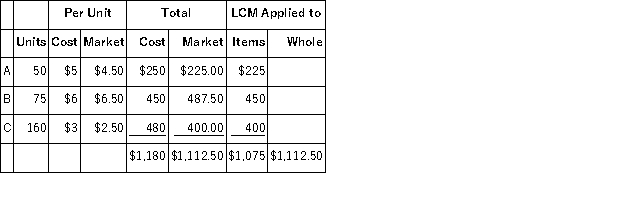
A company has the following per unit original costs and replacement costs for its inventory: Part A: 50 units with a cost of $5 and replacement cost of $4.50. Part B: 75 units with a cost of $6 and replacement cost of $6.50. Part C: 160 units with a cost of $3 and replacement cost of $2.50. Under lower of cost or market, the total value of this company's ending inventory must be reported as:


A) $1,180.00.
B) $1,075.00.
C) $1,112.50 or $1075.00, depending upon whether LCM is applied to individual items or the inventory as a whole.
D) $1,112.50.
E) $1180.00 or $1075.00, depending upon whether LCM is applied to individual items or to the inventory as a wholE. A company has the following per unit original costs and replacement costs for its inventory: Part A: 50 units with a cost of $5 and replacement cost of $4.50. Part B: 75 units with a cost of $6 and replacement cost of $6.50. Part C: 160 units with a cost of $3 and replacement cost of $2.50. Under lower of cost or market, the total value of this company's ending inventory must be reported as: A) $1,180.00. B) $1,075.00. C) $1,112.50 or $1075.00, depending upon whether LCM is applied to individual items or the inventory as a whole. D) $1,112.50. E) $1180.00 or $1075.00, depending upon whether LCM is applied to individual items or to the inventory as a wholE.
F) A) and B)
G) D) and E)

Correct Answer

verifed

verified

Showing 121 - 140 of 218

Related Exams

Show Answer